

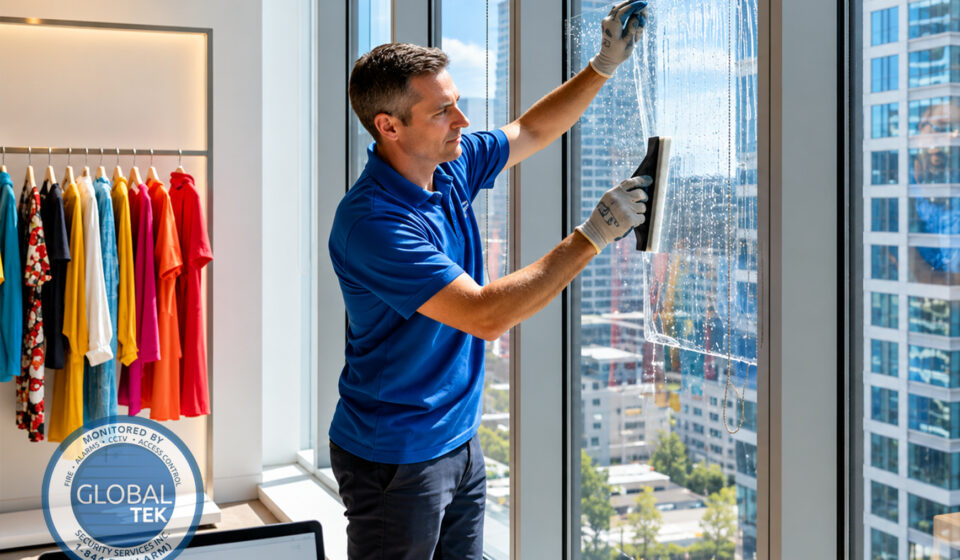

Walk around any home or storefront and ask a simple question: where would an intruder get in? The honest answer is almost always the same. Glass. Doors have deadbolts, walls are solid, but a window or glass door can be defeated with one swing of a hammer in under a second. Every alarm, camera, and lock in the building sits behind a barrier that shatters instantly.
Table Of Content
- What Is Security Window Film?
- How Security Window Film Works
- It Holds Shattered Glass Together
- It Buys the Most Valuable Thing in Security: Time
- It Contains Flying Glass in Accidents and Storms
- Types and Options
- The Benefits, Beyond Break-In Resistance
- Security Film vs. the Alternatives
- Where Security Window Film Makes the Most Sense
- Why Professional Installation Matters
- Frequently Asked Questions
- Is security window film burglar-proof?
- Will security film make my windows look tinted or darker?
- How long does security window film last?
- Can security film be installed on any type of glass?
- Reinforce Your Weakest Point
Security window film exists to close that gap. It is one of the most cost-effective physical security upgrades available, it works 24 hours a day without power or monitoring, and most people never notice it is there. Here is a complete look at what security window film is, how it actually works, and where it makes the biggest difference.
What Is Security Window Film?
Security window film is a heavy-duty, optically clear polyester (PET) laminate that bonds to the interior surface of existing glass using industrial-grade adhesives. Unlike the thin decorative or tint films sold in hardware stores, security film is engineered thick, typically several times thicker than solar film, and built in multiple micro-layers designed to absorb and distribute impact energy.
Once professionally installed and cured, the film and glass behave as a single reinforced unit. The glass can still break, but it can no longer fall apart.
How Security Window Film Works
It Holds Shattered Glass Together
Ordinary glass fails catastrophically: one impact and the entire pane collapses into fragments, leaving a wide-open entry point. With security film bonded to it, the glass cracks but the broken pieces remain adhered to the film membrane, held in place within the frame. The intruder is left facing a spiderwebbed but intact barrier instead of an open hole.
It Buys the Most Valuable Thing in Security: Time
Breaking through filmed glass requires repeated, prolonged, noisy blows, often a minute or more of sustained effort rather than a single silent second. Every second of that delay works against the intruder. The alarm is sounding, video verification monitoring operators are watching, neighbors are noticing, and response is already being dispatched. Most opportunistic intruders abandon the attempt entirely; smash-and-grab only works when the “smash” takes one hit.
It Contains Flying Glass in Accidents and Storms
The same energy-absorbing membrane that frustrates intruders also protects against everyday hazards. Wind-blown debris in a storm, an errant baseball, or an accidental fall against a patio door produces cracked, contained glass instead of dangerous flying shards, which is a meaningful safety upgrade for homes with children and for any business with the public near large panes.
Types and Options
- Clear safety and security film: maximum strength with virtually invisible appearance, the most popular choice for storefronts and homes
- Thickness grades: films come in multiple thicknesses, with heavier grades specified for higher-risk glazing such as ground-floor storefronts and glass entry doors
- Solar and tinted security film: combines break resistance with heat and glare rejection, cutting cooling costs while adding daytime privacy
- Frame anchoring systems: for maximum performance, the film edge is mechanically or structurally attached to the window frame, so the entire glazing system resists being pushed in as one unit
An assessment of your glass type, frame condition, and risk level determines the right specification; the correct film for an interior office partition is not the correct film for a street-facing storefront.
The Benefits, Beyond Break-In Resistance
Forced-entry delay is the headline, but security film quietly earns its cost in several other ways. It blocks the vast majority of ultraviolet light, protecting merchandise, flooring, artwork, and furniture from fading. Solar variants reduce heat gain and cooling load. It adds privacy without curtains or blinds. It deters “hate glass” vandalism economics, since a pane that will not open up is not worth attacking. And it does all of this invisibly, preserving natural light, sightlines, and the building’s appearance, which matters for retail displays and modern architecture alike.
Security Film vs. the Alternatives
Compared with bars and grilles, film is invisible, adds no institutional look, and never interferes with emergency escape through a window. Compared with replacing windows with laminated or polycarbonate glazing, film delivers a large share of the protection at a fraction of the cost, using the glass you already own, with far less disruption. And compared with doing nothing and relying on the alarm alone, film addresses the fundamental weakness that alarms cannot: the alarm reports the breach, but the film physically slows it down. The two together, detection plus delay, are the foundation of layered security.
Where Security Window Film Makes the Most Sense
Prime candidates include retail storefronts and display windows vulnerable to smash-and-grab, glass entry doors and sidelites on homes and offices, ground-floor and walkout basement windows, pharmacies, dispensaries, and jewelers, schools, daycares, and clinics, and any business or home where large glass areas are the obvious weak point. It also pairs naturally with commercial security cameras and monitored alarms, since the film holds the line while verified response is on the way.
Why Professional Installation Matters
Security film performance depends heavily on installation quality. The glass must be properly prepared, the film cut and applied without gaps or contamination, edges finished correctly, and anchoring systems installed where specified, then allowed to cure fully. Poorly installed film bubbles, peels at the edges, and sacrifices the very strength you paid for. Professional assessment also ensures the film grade matches your actual risk, so you are neither under-protected nor overspending.
Frequently Asked Questions
Is security window film burglar-proof?
No product makes glass impenetrable, and any company claiming otherwise should be avoided. What quality security film does is convert a one-second silent entry into a prolonged, loud, difficult struggle, which defeats the opportunistic attacks that make up the vast majority of break-ins and buys critical time for alarms and response to work.
Will security film make my windows look tinted or darker?
Only if you want it to. Clear security film is virtually invisible once installed and cured, preserving natural light and views, which is why storefronts favor it. Tinted and solar-control versions are available for owners who also want heat rejection, glare reduction, or daytime privacy.
How long does security window film last?
Professionally installed film on interior glass typically performs for well over a decade, and quality installations carry manufacturer warranties. The film does not require maintenance beyond normal window cleaning with non-abrasive products once it has fully cured.
Can security film be installed on any type of glass?
Most common glazing accepts security film, including annealed, tempered, and many double-pane insulated units, though the film specification changes with the glass type. Older or damaged glass, unusual coatings, and certain sealed units need professional evaluation first, which is one more reason a site assessment comes before any quote at GlobalTek Security.
Reinforce Your Weakest Point
GlobalTek Security Inc. has protected Canadian homes and businesses for more than 25 years, serving over 3,000 satisfied clients from our offices in Stoney Creek and Niagara Falls, Ontario. Every system we design is customized to your property, backed by rapid response dispatch, and offered with flexible agreements instead of long-term lock-in contracts. Call us today at +1-905-928-8564 or toll-free at +1-844-772-5276, or request a free quote online.
Securing you is all we do.