

Life is full of challenges, and one cannot predict what it has in store for you. So, all you can do is enjoy every day, live through every blessing and be prepared for whatever you can, as no one knows what comes next.
Table Of Content
Marriage happens to be one of the most beautiful and cherished parts of the life that people love to embrace, but as said, life is a mixture of fortunate and unfortunate things, and in order to stay prepared, all you can do is stay prepared.
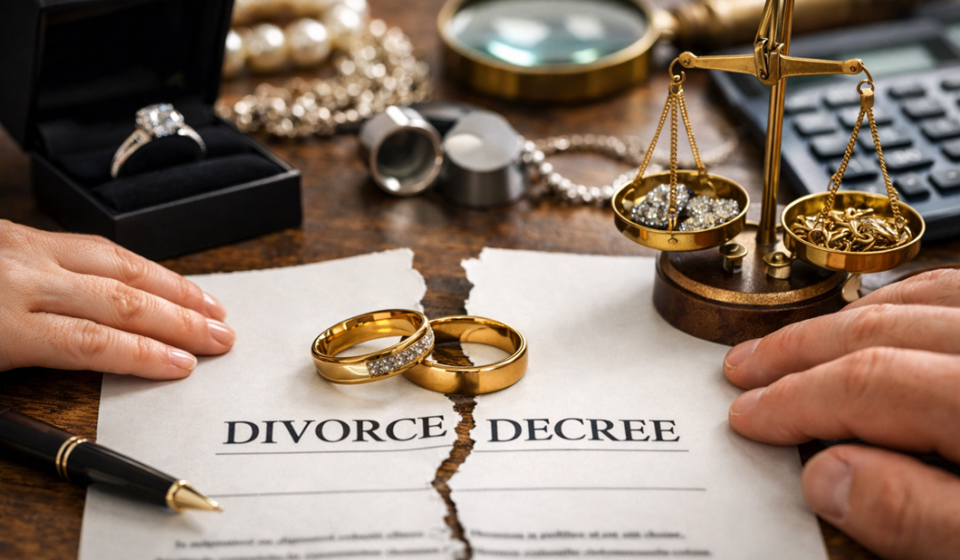
Divorce is something that happens only to a couple who have been in a marriage. The mental clarity and mental stability of the individuals are what truly matter, regardless of the controversy surrounding whether divorce is a good or bad decision. But when it comes to divorce, even if the two have mutually and happily decided to part ways, there are a number of things that can get complicated, and one among them is the division of the assets, especially the jewellery.
To some, divorce can be emotionally challenging if the couple is not separating on a mutually agreeable note, but for everyone, it is financially challenging, and when it comes to dividing assets, jewellery often becomes a sensitive topic.
If you are someone who does not have much idea about this part in detail, then you might be having several questions in your mind, like, “Do I get to keep my jewellery after divorce?” “Is my engagement ring mine, or does it get split?” and other such questions.
The truth is, there’s no one-size-fits-all answer. But don’t worry, this guide will help you with clear explanations, practical tips, and the role of getting the valuation done in time so that you get the division done fairly.
Is Jewellery Always Split in a Divorce?
No, this is not something which is necessarily done, and this is a topic where a number of people get confused. The most important factor in determining the fate of the jewellery is the history of how and when it was acquired.
Typically, the courts determine the course of action by categorising the assets into two groups: personal property and marital property.
-
Personal jewellery (usually not split)
There are a few items which are considered to be completely yours, and such items are not considered to be split. Listed below are a few things that may fall under this category.
- Engagement rings
- Gifts given specifically to you
- Family heirlooms passed down to you
In most of the cases, these assets remain with the person who bought them or to whom they were gifted. However, depending on the legal situations, the changes may be applied, such as when the heirlooms are subject to inheritance laws or divorce settlements that dictate how assets are distributed.
-
Marital jewellery (may be divided)
The jewellery becomes an asset that must be divided equally between the two parties if it meets the following criteria:
- Was purchased during the marriage
- Was bought using joint finances
- Holds significant financial value
These assets are considered to be the jewellery in divorce settlement for which a proper appraisal is required, as these items fall under the category which is to be fairly divided among the couple.
How Do Courts Decide Who Gets the Jewellery?
After serious consideration of several factors, these decisions are taken by the court and are not something that is randomly decided. There are a number of key considerations that are taken into account, and accordingly, the court decides what is to be done.
Key considerations include the following:
- Ownership – Who originally bought or received the item?
- Timing – Was it acquired before or during the marriage?
- Purpose – Was it a personal gift or shared investment?
- Financial balance refers to the overall distribution of assets.
For example, the court can divide the jewellery, or if a person wants to keep the maximum part or maybe even all the jewellery, the other person is compensated with cash which is equal to the worth of the jewellery.
Why Jewellery Valuation Is Essential?
Jewellery valuation is the most important thing that needs to be carried out in such situations. If a situation arises where one person believes the jewellery is worth a different amount than the other, the question becomes, “Who’s right?”
Now, this is a confusion that easily gets cleared or most often does not even arise when there is a proper valuation document to support the total worth of the jewellery in consideration. Without an accurate valuation, disagreements can quickly escalate. One partner may overestimate sentimental value, while the other may underestimate financial worth.
Summing Up
To sum up, valuation plays an extremely important role in deciding the worth of the jewellery, be it the jewellery in divorce settlement or be it the probate case. Therefore, in such situations, the court will decide who gets what part, but what makes it easier and rapid is the documentation of divorce or probate jewellery valuation.