
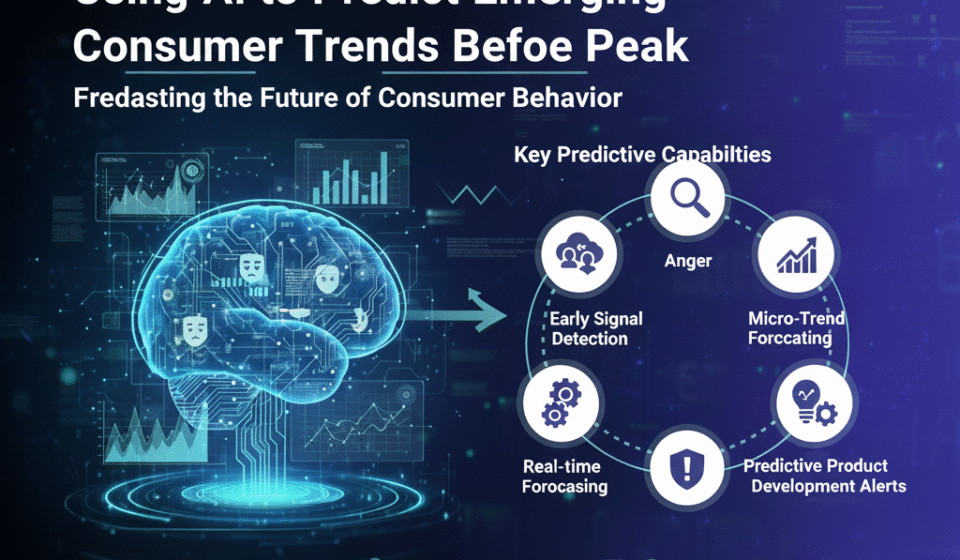

In fast-moving markets, timing is everything. Brands that identify trends early win market share, while those that react too late struggle to stay relevant. This is why organizations are increasingly using AI to uncover consumer trend insights and apply advanced trend forecasting techniques long before trends reach their peak. By analyzing massive volumes of behavioral, cultural, and conversational data, AI enables businesses to move from reactive analysis to proactive strategy.
Table Of Content
- Why Predicting Trends Early Matters
- What Are Emerging Consumer Trends?
- How AI Identifies Consumer Trend Insights Before They Peak
- 1. Analyzing Massive Volumes of Unstructured Data
- 2. Natural Language Processing and Semantic Understanding
- 3. Detecting Weak Signals and Accelerating Patterns
- The Role of AI in Trend Forecasting
- From Descriptive to Predictive Analysis
- Scenario Modeling and Forecast Accuracy
- Why Consumer Trend Insights Are a Competitive Advantage
- Faster Innovation Cycles
- More Relevant Marketing
- Stronger Market Positioning
- Reduced Business Risk
- Real-World Applications of AI Trend Forecasting
- Product Development
- Retail and Merchandising
- Brand Strategy and Innovation
- Investment and Planning
- Challenges in Predicting Emerging Trends with AI
- Separating Signal From Noise
- Human Interpretation Still Matters
- Ethical and Privacy Considerations
- Best Practices for Using AI in Trend Forecasting
- Conclusion: Winning the Future With AI-Driven Trend Forecasting
- FAQ: AI and Predicting Consumer Trends
- What are consumer trend insights?
- How does AI improve trend forecasting?
- Can AI predict trends before they go mainstream?
- Is AI trend forecasting accurate?
- Which industries benefit most from AI-driven trend forecasting?
This article explores how AI predicts emerging consumer trends, why early detection matters, and how companies can turn early signals into sustainable growth.
Why Predicting Trends Early Matters
Traditional trend analysis often relies on historical sales data, surveys, or periodic research reports. While useful, these methods tend to identify trends only after they are already established.
AI-driven trend forecasting changes this dynamic by:
- Detecting weak signals before trends go mainstream
- Analyzing unstructured data like text, images, and conversations
- Continuously monitoring shifts in consumer behavior
As a result, AI delivers forward-looking consumer trend insights that help brands anticipate demand instead of chasing it.
What Are Emerging Consumer Trends?
Emerging consumer trends are early-stage shifts in behavior, preferences, or values that have not yet reached mass adoption. These trends often start small—within niche communities, early adopters, or specific cultural contexts.
AI-powered trend forecasting excels at identifying these early indicators, such as:
- Subtle changes in language or sentiment
- New product use cases discussed online
- Growing interest in niche topics or categories
Capturing these early signals is the foundation of effective consumer trend insights.
How AI Identifies Consumer Trend Insights Before They Peak
1. Analyzing Massive Volumes of Unstructured Data
AI processes data from sources such as:
- Social media conversations
- Online reviews and forums
- Search behavior
- News, blogs, and creator content
Humans cannot analyze this scale of information efficiently. AI systems surface patterns across millions of data points to generate early consumer trend insights.
2. Natural Language Processing and Semantic Understanding
Natural Language Processing (NLP) allows AI to understand how consumers talk about products, lifestyles, and needs.
Instead of tracking keywords alone, AI:
- Understands context and meaning
- Detects emerging themes
- Identifies shifts in sentiment and intent
This semantic understanding improves trend forecasting accuracy and reduces false signals.
3. Detecting Weak Signals and Accelerating Patterns
Early trends often appear as weak signals—small but consistent increases in discussion or engagement. AI excels at identifying:
- Gradual increases in topic frequency
- Cross-channel pattern alignment
- Sudden acceleration points
By recognizing these signals early, brands gain access to consumer trend insights before competitors notice them.
The Role of AI in Trend Forecasting
From Descriptive to Predictive Analysis
Traditional analytics explain what already happened. AI-driven trend forecasting predicts what is likely to happen next.
AI models:
- Analyze historical and real-time data together
- Identify trend trajectories
- Estimate growth potential and longevity
This allows brands to distinguish between short-lived fads and long-term shifts.
Scenario Modeling and Forecast Accuracy
Advanced AI systems simulate multiple future scenarios based on current signals. This enables:
- Risk assessment
- Strategic planning
- Smarter investment decisions
Accurate trend forecasting reduces uncertainty and supports confident decision-making.
Why Consumer Trend Insights Are a Competitive Advantage
Faster Innovation Cycles
Brands that access early consumer trend insights can design products, features, or services ahead of demand.
More Relevant Marketing
Early trend detection allows marketing teams to align messaging with emerging interests rather than outdated narratives.
Stronger Market Positioning
Companies that act early are often perceived as category leaders rather than followers.
Reduced Business Risk
AI-based trend forecasting helps brands avoid over-investing in declining or short-lived trends.
Real-World Applications of AI Trend Forecasting
Product Development
AI identifies unmet needs and evolving preferences, guiding R&D and product roadmaps.
Retail and Merchandising
Retailers use consumer trend insights to optimize assortments, pricing, and inventory before demand spikes.
Brand Strategy and Innovation
Strategic teams rely on trend forecasting to explore new markets, partnerships, and brand extensions.
Investment and Planning
AI trend signals inform long-term planning, reducing reliance on assumptions or outdated data.
Challenges in Predicting Emerging Trends with AI
Separating Signal From Noise
Not all emerging topics become meaningful trends. AI models must be trained to:
- Filter out short-term hype
- Validate trends across multiple data sources
Human Interpretation Still Matters
AI surfaces insights, but humans provide context, creativity, and strategic judgment.
Ethical and Privacy Considerations
Responsible data usage is critical when analyzing consumer behavior at scale.
Best Practices for Using AI in Trend Forecasting
- Combine AI insights with human expertise
- Focus on trend direction and momentum, not just volume
- Validate insights across channels and regions
- Track trends over time, not in isolation
- Align consumer trend insights with business objectives
Following these practices ensures trend forecasting delivers real value, not just interesting data.
Conclusion: Winning the Future With AI-Driven Trend Forecasting
In an era where consumer behavior shifts rapidly, waiting for trends to peak is no longer an option. AI-powered trend forecasting enables brands to anticipate change, innovate faster, and stay ahead of the curve.
By unlocking early consumer trend insights, organizations move from reacting to trends to shaping them. The brands that succeed in the future will not be the ones that follow demand—but the ones that predict it.
FAQ: AI and Predicting Consumer Trends
What are consumer trend insights?
Consumer trend insights reveal emerging patterns in consumer behavior, preferences, and attitudes that influence future demand.
How does AI improve trend forecasting?
AI improves trend forecasting by analyzing large-scale data in real time, detecting weak signals, and predicting trend trajectories.
Can AI predict trends before they go mainstream?
Yes. AI excels at identifying early indicators and acceleration patterns that signal emerging trends before mass adoption.
Is AI trend forecasting accurate?
AI significantly improves accuracy, especially when insights are validated with human expertise and multiple data sources.
Which industries benefit most from AI-driven trend forecasting?
Retail, CPG, technology, media, finance, and healthcare all benefit from AI-powered consumer trend insights.