
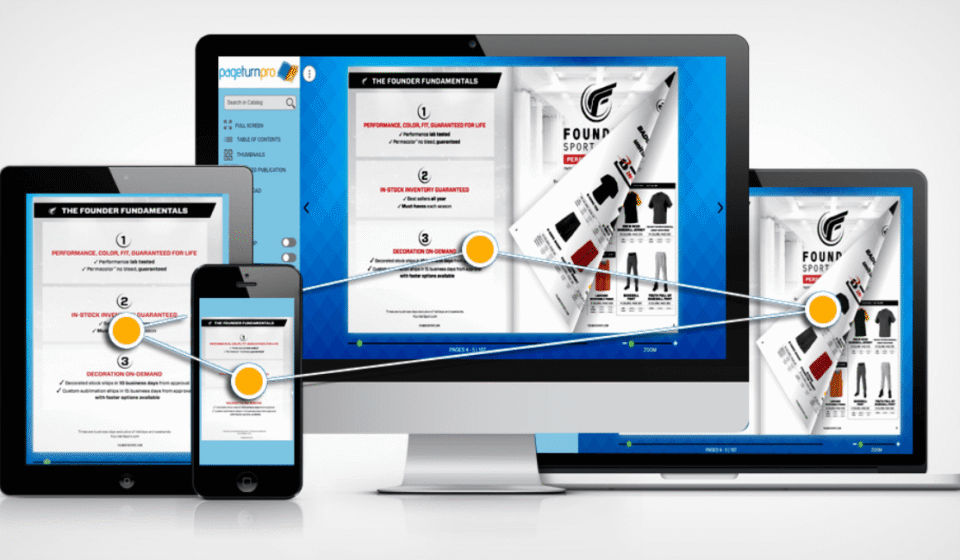

And what was the last time you had attempted to read a regular PDF in your smartphone? You must have spent more pinching and zooming and scrolling horizontally than actually reading the content. It is not only a cumbersome, annoyed experience that tends to cause users to give up the document. Nevertheless, the Portable Document Format is still widely used to make brochures, white papers, and catalogs by businesses. Although PDFs were an innovative method of distributing documents to be printed in 1990s, this was not designed to be a mobile-first web. These are immobile, hard to follow and hard to come by in small screens. Enter the digital magazine. By turning your passive documents into dynamic online editions, you turn a one dimensional reading experience into a three dimensional experience. Transform PDF to digital magazine!
Table Of Content
- Why the PDF needs an upgrade?
- Mobile responsiveness
- Interaction and involvement.
- Analytics and intelligence
- Step 1: Preparation & optimization
- Step 2: Picking your conversion medium
- Step 3: The enrichment phase
- Embedding rich media
- Internal & external links
- Step 4: Publishing & distribution
- Conclusion
The digital magazines have page flipping effects, videos are integrated with them and direct shopping links and responsive designs that can fit any device. More to the point, they give statistics. Digital magazines also give you the ability to see who is reading, what he or she is clicking on, and how long he or she remains interested, unlike a PDF which after downloading, becomes a black box.
Why the PDF needs an upgrade?
It is always helpful to find out the why before diving into how. The marketing teams are usually reluctant to abandon PDFs since the workflow is already established. Altering such a process is not easy; however, the payback is high due to three main reasons.
Mobile responsiveness
On the mobile devices, we consume more content as compared to the desktops. A PDF will remain in its fixed format regardless of the size of the screen. This compels the mobile users to scroll a massive document on a small screen. Digital magazines especially those based on the HTML5 technology can reflow the text and images in a manner that it suits the screen of the user, and so the reader can have a smooth reading experience.
Interaction and involvement.
A PDF is a paper piece that is digital. You are able to read it, not to be able to interact with it. A digital magazine is in favor of rich media. You are free to insert a video on YouTube describing a product right on the page, make use of GIF animation to attract attention to headers, or design a pop-up overlay to complex charts. This holds the readers on the page and offers them more chances to be converted.
Analytics and intelligence
This is the game-changer of the marketers. Your tracking is terminated when a person downloads a PDF. you know not whether they opened it, or leaf 5, or erased it out of existence. Granular analytics is provided in digital magazine platforms. There are heat maps of where they have clicked, articles that people have not read, and how much time they spend on individual pages.
Step 1: Preparation & optimization
The process of conversion starts even before you start a specialized software. Although numerous tools promise to do wonders to any file, your input defines the quality of the output.
Start with an audit on your existing PDF design. In case your document was intended to be printed in a CMYK color profile, ultra-high-resolution images so that it can be printed at 300 DPI, then you must optimize your text to the internet. Convert colors to RGB to showcase them in the color screen. You would prefer the images to be crisp but enormous file size will reduce the speed at which your digital magazine loads. Web image optimization will make your magazine load immediately and this is critical to capturing impatient web traffic.
Step 2: Picking your conversion medium
The are many tools in the online market that can convert PDF to digital magazine. It is up to you and the amount of money you have, and the features you want.
The most used platform is PageTurnPro digital magazine software.
Step 3: The enrichment phase
It is at this point that the magic is created. As soon as you have uploaded your PDF to your preferred platform, you no longer have any reason to continue treating it as a document, but turn to a multimedia experience.
Embedding rich media
Look through your material to get chances to substitute fixed text with moving media. Is there a customer testimonial that is written? Substitute it with (or place it beside) an audio or video of the customer talking. Was there a screenshot of your software that is static? Rather, utilize a looping GIF demonstrating a specific feature in action.
Internal & external links
Links are small and difficult to tap in a PDF file. You are supposed to include hotspots during the enrichment stage. These are interactive spaces that glow or move on a hover of the user. Use these for:
- Navigation: Have a table of contents that is a clickable section that takes one to a given section.
- Trade: Have product pictures connected to your checkout.
- Resources: Add links to external resources or other blog posts in order to improve your SEO structure.
Step 4: Publishing & distribution
When you have polished your magazine now you are going to publish. Your digital magazine exists on a URL as opposed to a PDF whereby the user has to download a file. The implication of this otherwise minor difference on distribution is huge.
You will easily be able to incorporate the magazine in one of the pages of your web site, keeping the traffic there. Or you can send the direct link via emails and other social media. This is due to the fact that there is no heavy attachment to download and open rates and click-through rates tend to increase.
Moreover, it becomes easy to update. When someone discovers a typo in a distributed PDF, they have to correct it and resend it to all people. Under a digital magazine, you just make changes in the back-end, and all people who are accessing the link will get the new version immediately.
Conclusion
The advent of interactive online magazine as the replacement of the static PDF is not a fad; it is a reaction to the changing method of information consumption by the contemporary audience. The consumers demand speed, interactivity, and portability. Businesses that remain in stagnant forms will be seen as old-fashioned and uninterested.
The conversion process of PDF to digital magazine, which is to prepare your assets, to choose the appropriate platform and to enrich the content with media, is an investment into the digital presence of your brand. It transforms passive readers into active users and gives you the data, which allows you to constantly improve your content strategy.
Are there eBooks or catalogs or reports that are collecting digital dust in your library? It is high time to unleash the power of eBooks. Select a file, select an experience, and begin creating a reading experience that your audience will actually look forward to reading.