In overhead transmission and distribution networks, bare conductor remains one of the most critical components for reliable and cost-effective power delivery. For utility engineers, EPC contractors, and procurement teams, selecting the right bare overhead conductor directly affects line performance, mechanical safety, project lifecycle cost, and long-term grid stability.
As a global manufacturer of overhead conductors and power cables, HNBF Power supplies utility-grade bare conductor solutions for transmission lines, sub-transmission corridors, and distribution projects worldwide.
This technical guide explains how to evaluate bare conductor types, performance criteria, and application scenarios from a professional utility and infrastructure perspective.
What Is a Bare Conductor in Power Transmission?
A bare conductor is an uninsulated overhead line conductor designed to carry electrical current in open air. It relies on physical clearance and structural design rather than insulation to ensure electrical safety.
Bare conductors are widely used for:
High-voltage and medium-voltage transmission lines
Urban and rural distribution networks
Substation bus connections
Temporary and permanent utility installations
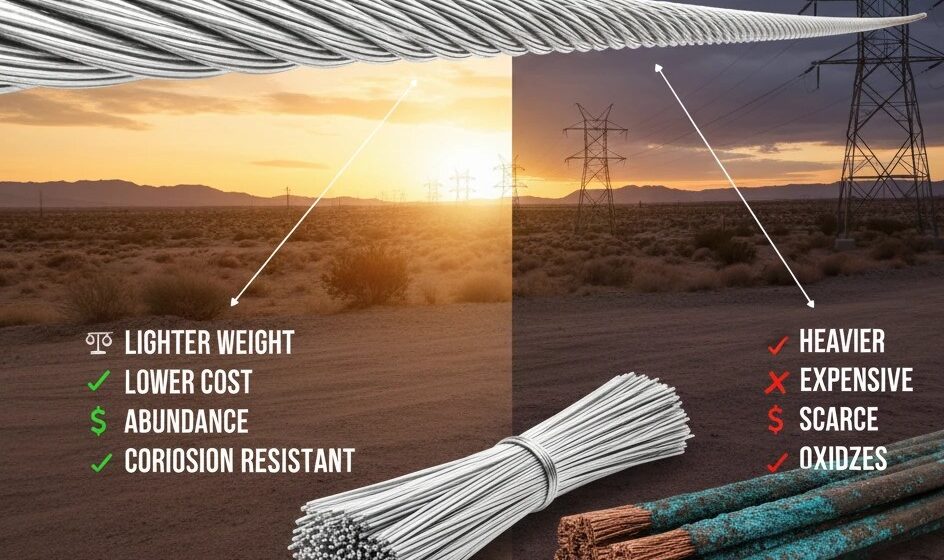
Compared with insulated cables, bare conductors provide superior thermal performance, simpler installation, and lower material cost for large-scale overhead networks.
Main Types of Bare Conductor Used by Utilities
Modern utility projects normally select bare conductors from three proven product families.
AAC – All Aluminum Conductor
AAC bare conductor is manufactured from high-purity aluminum strands.
Typical advantages
High electrical conductivity
Lightweight structure
Excellent corrosion resistance
AAC is often selected for urban distribution and coastal environments where corrosion performance and low sag requirements are moderate.
AAAC bare conductors are widely applied in modern distribution and medium-voltage overhead lines where mechanical reliability is a priority.
ACSR – Aluminum Conductor Steel Reinforced
ACSR combines aluminum strands with a galvanized steel core.
Why utilities choose ACSR
Excellent mechanical strength
Superior long-span performance
Proven reliability for transmission projects
For high-voltage transmission corridors, river crossings, and mountainous routes, ACSR bare conductor remains a preferred industry solution.
Critical Technical Parameters When Selecting Bare Conductor
For engineers and procurement teams, selecting the right bare conductor is not only about conductor size. It requires careful evaluation of electrical, mechanical, and environmental performance.
Current Carrying Capacity (Ampacity)
Bare conductor ampacity depends on:
Strand construction
Ambient temperature
Wind speed and solar radiation
Maximum allowable conductor temperature
Higher ampacity allows utilities to increase power transfer without upgrading tower structures.
Mechanical Strength and Sag Performance
Mechanical performance directly influences:
Maximum span length
Ground clearance compliance
Structural loading of poles and towers
AAAC and ACSR bare conductors are typically preferred when long spans and low sag under high temperature are required.
Corrosion and Environmental Resistance
For coastal, industrial, or high-humidity regions, conductor material selection plays a critical role in long-term reliability.
Aluminum alloy and specially protected ACSR designs significantly improve service life under aggressive environmental conditions.
Compliance with International Standards
Bare conductors supplied for utility projects should comply with recognized international specifications such as those issued by ASTM International and the International Electrotechnical Commission.
Standardized testing ensures:
Conductor diameter and stranding accuracy
Electrical resistance consistency
Mechanical tensile performance
Why Bare Conductor Remains Essential for Modern Grids
Despite the growing use of covered conductors and insulated cables, bare conductor still dominates large-scale grid infrastructure because of:
Lower total project cost per kilometer
Simplified installation and stringing
Excellent heat dissipation under high load
Proven compatibility with existing hardware systems
For grid reinforcement and network expansion projects, bare overhead conductor allows utilities to optimize capital expenditure without sacrificing performance.
Manufacturing Quality Matters in Bare Conductor Projects
In large transmission and distribution contracts, conductor manufacturing quality directly impacts project risk and operational reliability.
HNBF Power integrates:
Automated stranding technology
Precise tension control during production
Strict raw material traceability
Routine mechanical and electrical testing
This manufacturing discipline enables consistent performance across AAC, AAAC, and ACSR bare conductor ranges for utility and EPC clients.
Application Scenarios for Bare Conductor in Utility Projects
Transmission Lines
ACSR and high-strength AAAC bare conductors are commonly used for:
110 kV to 500 kV transmission systems
Long-distance power evacuation corridors
Renewable energy grid connection projects
Distribution Networks
For medium-voltage and low-voltage overhead lines, AAC and AAAC bare conductors provide:
Lightweight construction
Lower structure loading
Faster deployment for rural electrification
Substation Bus Systems
Bare conductor is also widely used for rigid and flexible bus connections inside substations, where high current capacity and mechanical stability are required.
How HNBF Power Supports Utility and EPC Buyers
As a specialized manufacturer of overhead conductors and power cables, HNBF Power delivers:
Customized conductor design based on project loading and climate conditions
Flexible stranding constructions and core configurations
Technical documentation and type test support
Stable bulk supply for multi-phase grid projects
By working closely with engineering consultants and procurement teams, HNBF Power helps reduce technical risk and ensure compliance with project specifications.
Frequently Asked Questions (FAQs)
1. What is the main difference between bare conductor and insulated overhead cable?
Bare conductor has no insulation and relies on clearance and line design for safety, while insulated overhead cables use polymer layers to provide additional electrical protection.
2. Which bare conductor is best for long transmission spans?
ACSR bare conductor is generally preferred for long spans and high mechanical loading because of its steel-reinforced core.
3. Can AAAC replace ACSR in transmission projects?
In many medium-span and medium-voltage projects, AAAC bare conductor can replace ACSR where corrosion resistance and reduced maintenance are priorities.
4. How do utilities select the correct conductor size?
Conductor size is selected based on required ampacity, allowable sag, short-circuit performance, and local environmental conditions.
5. Does HNBF Power offer customized bare conductor designs?
Yes. HNBF Power provides customized stranding, alloy composition, and mechanical configurations to match specific transmission and distribution project requirements.
Power Your Next Grid Project with the Right Bare Conductor
Selecting the right bare conductor is a strategic decision that affects grid performance, safety, and long-term operational cost. From urban distribution networks to high-capacity transmission corridors, properly engineered bare conductors ensure reliable energy delivery in every operating environment.
Contact HNBF Power today to discuss your project requirements and receive customized bare conductor solutions designed specifically for your utility or EPC application.